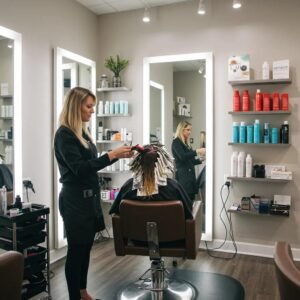
Cowlicks follow your hair’s natural growth direction, which can make some haircut shapes and styling routines harder to maintain. A cut planned around the way your hair falls may help a fringe sit more comfortably, soften visible crown lift, or make a neckline easier to manage. The useful question is how much length, texture and daily effort suit your particular pattern.
Key takeaways
Look at the front hairline, crown and nape separately; one approach may not suit all three.
Keeping length can add useful weight, while a shorter shape can make natural lift part of the style. Neither is a universal fix.
Reference photos show a finished look, but cannot reveal how your own growth direction will behave.
A haircut changes shape and weight. Styling changes the temporary position of the strands; neither should be described as retraining the follicles.
Locate the pattern before choosing a cut
A cowlick is an area where hair grows in a direction different from the surrounding hair, often creating a swirl, split or raised section. It is a normal growth pattern. Calling it hair that grows the “wrong” way is less useful than noticing where it changes direction and how it affects the shape you want.
Observe your hair on an ordinary day, including how it falls after air-drying if that is your usual routine. Notice whether a part opens on its own, a section lifts when short, or a neckline turns outward. You do not need to diagnose the follicle angle. These observations simply give you specific details to discuss with a stylist.
Front hairline and fringe
A front cowlick may separate a fringe or lift one side away from the forehead. Before choosing short, blunt bangs, ask how that section is likely to sit with your usual styling routine. A longer fringe, a softer edge or a part closer to the natural separation may be options. The choice depends on the amount of hair available, its texture and the direction of the split.
Keeping extra length can provide more styling flexibility, but longer does not automatically mean flat. Explain whether you want the fringe to fall forward, sweep aside or stay off your face. Each goal places different demands on the same growth pattern.
Crown whorl
At the crown, hair may radiate around a whorl and expose more scalp when it separates. A very short layer can stand up on one person and blend into an intentionally textured shape on another. Ask your stylist to compare retaining crown length with a shorter design that accommodates lift.
Do not assume that more thinning or texturizing will make a crown lie down. Removing weight can change the way the section behaves. Before agreeing to substantial length removal, discuss the likely effect on coverage, volume and the amount of styling needed.
Nape and neckline
At the nape, upward or sideways growth can influence the edge of a pixie, crop or short bob. A tightly cut neckline may reveal the pattern, while a little more length may soften it. Some people prefer a shaped edge that follows the natural growth; others prefer a longer perimeter. Ask what the neckline may look like as the cut grows, rather than judging only the freshly finished result.
Compare length, weight and texture
There is no single best haircut for every cowlick. Think of length and weight as design choices with tradeoffs. Retaining hair around a raised area may help it settle or make it easier to redirect. A shorter shape may reduce the contrast between the lifted section and the rest of the cut, while leaving more visible texture.
The surrounding hair matters too. Fine hair may have less weight available, and dense hair may need a different balance of shape and bulk. Waves and curls can change the visible length and direction after drying. Ask how the proposed cut will behave in your usual texture, not only after a polished finish.
Sam Villa’s professional discussion of growth patterns addresses crown length and styling around the fringe and nape. It supports treating these areas as separate design considerations, rather than applying one rule to every swirl. Cutting techniques belong in a stylist’s assessment, rather than a home cutting experiment.
Use reference photos as a conversation starter
Bring photos of the shape you like, ideally showing the front, side and back. Explain the feature you want: a soft fringe, a close neckline, a fuller crown or an easy side part. That is more helpful than asking for an exact copy of the whole picture.
A photo cannot show the model’s natural growth direction beneath the finished style. It may also reflect different density, texture, head shape, styling products or professional preparation. Ask which features can be adapted to your hair and which would require regular effort.
Bring a photo of your own hair on a difficult morning as well. A picture of the fringe splitting or the crown lifting can be useful if the section happens to sit differently at the appointment. These images describe your experience; they are not a guarantee of a particular result.
Match the haircut to your daily styling effort
Be clear about how you usually dry your hair and how much time you want to spend on it. A shape that works for someone who enjoys blow-drying may feel demanding if you prefer to air-dry. Ask what the cut is likely to look like with minimal styling and what extra steps create the more polished version.
Styling can temporarily redirect strands, but it does not change the underlying follicle direction. Humidity, washing, movement and your texture can affect how long a styled result holds. Avoid planning around a promise that a cowlick will disappear or stay controlled for a fixed period.
Keep styling comfortable and realistic
Ask your stylist to demonstrate a gentle method suited to your hair and tools. If heat styling is part of the routine, discuss heat protection, a suitable setting and comfortable airflow. More heat or stronger pulling is not a reliable answer to a resistant section. Stop if the scalp feels hot or the technique causes discomfort.
Product choice should support the finish you want. A light hold product may help some styles, while heavier products can change separation or volume. Start with the stylist’s guidance and the product directions rather than assuming every cowlick needs mousse, wax or a round brush. The simplest routine you can repeat comfortably is often the most useful one.
Prepare for a haircut conversation in Bethesda
Kylie Studio Salon’s Women’s Haircut and Blow-Dry service includes a consultation and a haircut tailored to hair texture, face shape and lifestyle. Use that discussion to explain where your growth pattern affects the shape you want. A separate “cowlick correction” service is not needed to describe your concern.
Point out the front, crown or nape section that gives you difficulty.
Describe how it behaves after your usual wash-and-dry routine.
Bring inspiration photos and identify the features you like.
Ask where retaining length may help and where a shorter shape could be practical.
Discuss your preferred styling time and comfort with maintenance.
Confirm booking details and pricing directly with the salon.
Ask the salon how to prepare your hair for the appointment rather than assuming a particular arrival routine. Before substantial changes, discuss how much length will come off in the area that concerns you and what to expect between visits.
Frequently asked questions
Can a haircut permanently remove a cowlick?
A haircut changes the visible shape and weight of the hair; it should not be expected to remove the underlying growth pattern. The practical goal is a cut and routine that make the pattern easier to live with.
Should a cowlick always be kept long?
No single length suits everyone. Extra length may provide useful weight or flexibility, while a shorter textured style may suit someone comfortable with natural lift. Compare both options in the context of your hair and daily routine.
Can I choose bangs with a front cowlick?
A front cowlick does not automatically rule out a fringe. The length, part and finish may need adapting, and some shapes require more styling than others. Ask how the proposed fringe will sit on an ordinary day.
What should I prioritize when choosing the shape?
Start with the way your hair naturally falls, the features you want and the effort you can maintain. A clear conversation about those three things is more useful than a promise of an effortless or identical result.